
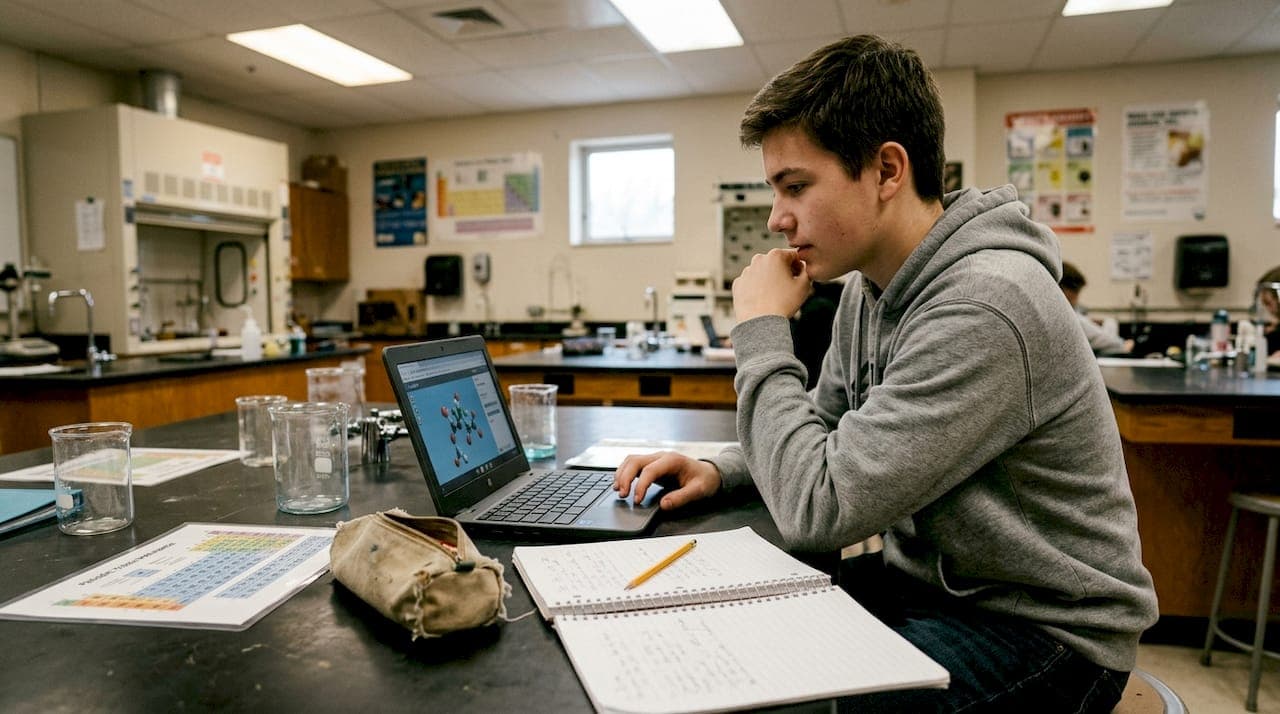
Many teachers view interactive chemistry tools as mere digital eye candy, assuming they add visual appeal but little substance to learning. Yet research reveals these platforms fundamentally transform how students grasp invisible molecular phenomena by bridging the gap between what they observe and the underlying atomic interactions. When integrated thoughtfully with teacher guidance, interactive simulations turn abstract concepts into tangible experiences that spark curiosity and deepen comprehension. This guide explores evidence-based strategies for maximizing these tools' impact in your high school chemistry classroom.
Table of Contents
- Key Takeaways
- How interactive chemistry tools transform conceptual understanding
- The crucial role of teacher scaffolding in maximizing learning gains
- Addressing challenges and nuances with interactive chemistry tools
- Practical guidance for choosing and implementing interactive chemistry tools
- Discover Atomency's free interactive chemistry platform
- Frequently asked questions
Key Takeaways
| Point | Details |
|---|---|
| Bridge three levels | Interactive tools connect macroscopic observations, submicroscopic particle behavior, and symbolic equations to strengthen conceptual understanding. |
| Real time hypothesis testing | Students adjust variables such as temperature or concentration and observe outcomes instantly to develop intuition about chemical behavior. |
| PhET as flexible resource | Free platforms like PhET offer accessible simulations that support diverse learning environments. |
| Teacher scaffolding is essential | Guided inquiry with structured scaffolding turns simulations from toys into rigorous learning experiences. |
How interactive chemistry tools transform conceptual understanding
Chemistry learning requires students to navigate three interconnected levels: the macroscopic world of visible reactions, the sub-microscopic realm of atoms and molecules, and the symbolic language of equations and formulas. This framework, known as Johnstone's triangle, presents a persistent challenge because students struggle to mentally link what they see in a beaker to invisible particle movements and abstract notation. Traditional instruction often leaves the sub-microscopic level to imagination, creating gaps that hinder mastery.
Interactive chemistry platforms address this challenge by making invisible processes visible and manipulable. When students adjust pH in a virtual solution, they simultaneously observe color changes at the macroscopic level, watch hydrogen ions attach to molecules at the sub-microscopic level, and see corresponding equation updates at the symbolic level. This synchronized visualization creates cognitive bridges that static diagrams cannot achieve. A review of 31 studies showed PhET enhanced conceptual understanding by bridging Johnstone's triangle levels, with students demonstrating stronger connections between representations.
The benefits extend beyond visualization. Interactive tools enable students to test hypotheses immediately, adjusting variables like temperature or concentration and observing outcomes in real time. This iterative experimentation builds intuition about chemical behavior that lecture-based instruction rarely cultivates. Students develop predictive skills as they anticipate how molecular arrangements will change under different conditions.
"The power of interactive simulations lies not in replacing physical experiments, but in revealing the molecular story behind observable phenomena, transforming chemistry from memorization to exploration."
Core visualization features that drive learning gains include:
- Animated molecular behavior showing collisions, bond formation, and electron transfers
- Dynamic reaction representations that update as students manipulate conditions
- Synchronized symbolic equations that reflect real-time changes in particle arrangements
- Color-coded atoms and ions that help students track species through complex reactions
- Adjustable timescales allowing observation of fast reactions and equilibrium processes
These features work synergistically to build mental models. When students see molecules speed up as temperature increases while simultaneously watching reaction rate graphs climb, they construct mechanistic understanding rather than memorizing isolated facts. The visual feedback loop reinforces cause-and-effect relationships that remain abstract in traditional settings.
The crucial role of teacher scaffolding in maximizing learning gains
While interactive tools offer powerful visualization capabilities, their educational impact depends heavily on how teachers structure their use. Scaffolding, the strategic support that guides students through inquiry while gradually building independence, transforms simulations from digital toys into rigorous learning experiences. Without this framework, students may engage superficially, clicking through scenarios without developing deeper conceptual insights or even forming misconceptions.

Scaffolding takes two primary forms in simulation-based learning. Static scaffolding includes embedded prompts, prediction questions, and structured worksheets that guide exploration. Dynamic scaffolding involves real-time teacher facilitation, questioning, and adaptive support based on student responses. Research shows that synergistic scaffolding with static and dynamic support leads to higher conceptual gains compared to simulations alone, with students demonstrating stronger retention and transfer abilities.
Effective scaffolding strategies include:
- Pre-simulation predictions where students hypothesize outcomes before exploring, creating cognitive investment in results
- Structured exploration guides that pose specific questions requiring manipulation of variables and observation of patterns
- Collaborative activities pairing students to discuss observations and challenge each other's interpretations
- Post-simulation reflection prompts connecting virtual observations to chemistry equations and real-world applications
- Integration with complementary hands-on labs that validate or extend simulation findings
- Whole-class debriefs where students share discoveries and the teacher addresses misconceptions
The timing and intensity of scaffolding matter significantly. Beginning with more structured guidance and gradually releasing responsibility as students gain confidence optimizes learning. For complex simulations involving multiple variables, teachers might initially constrain exploration to one or two factors before opening full functionality. This prevents cognitive overload while building foundational understanding.
Pro Tip: Never allow students to use simulations in unguided free-play mode during initial learning. Without structure, they often focus on entertaining but educationally shallow interactions, missing the conceptual depth that makes these tools valuable. Always frame exploration with specific learning goals and reflection requirements.
Teachers can document their scaffolding approaches and share insights through platforms that support educator collaboration. Reviewing interactive tool development insights helps you understand design principles that inform effective pedagogical strategies, enabling you to align your scaffolding with tool capabilities.
Addressing challenges and nuances with interactive chemistry tools
Despite their benefits, interactive chemistry tools present implementation challenges that teachers must navigate thoughtfully. Complexity varies dramatically across platforms, with some simulations overwhelming students through excessive features or advanced computational chemistry concepts. Tools like Comp-Chem-Lab, while powerful for quantum mechanical modeling, require substantial background knowledge and teacher mediation to prevent misinterpretation of results. Students may struggle with interfaces that demand simultaneous attention to multiple representations or unfamiliar navigation paradigms.
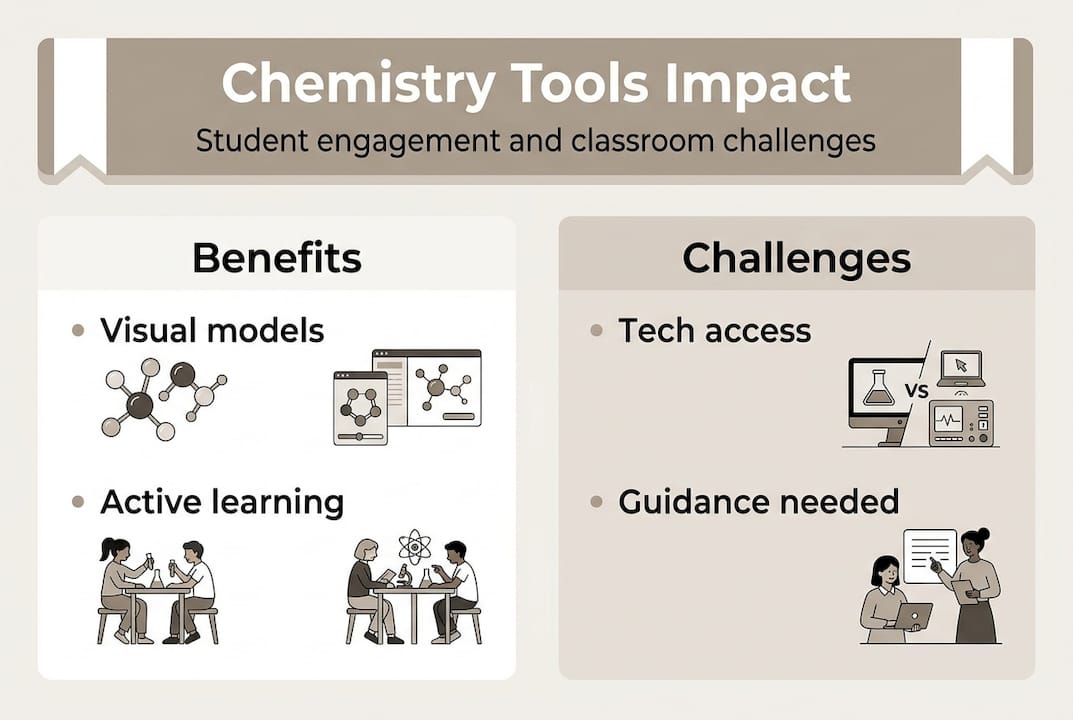
Free, user-friendly tools like PhET offer lower entry barriers with intuitive designs focused on core concepts rather than comprehensive modeling. These platforms prioritize accessibility over exhaustive functionality, making them ideal starting points for teachers new to simulation-based instruction. However, even simplified tools can mislead if students misinterpret visual representations or overgeneralize from specific examples. Research indicates that tools require adapted complexity and teacher integration to avoid misinterpretations, with free tools helping mitigate access disparities in under-resourced schools.
| Tool feature | PhET simulations | Comp-Chem-Lab | VirtualChemLabs |
|---|---|---|---|
| Complexity level | Low to moderate | High | Moderate |
| Cost | Free | Subscription | Free/paid tiers |
| Recommended scaffolding | Moderate | Intensive | Moderate to high |
| Best for | Conceptual foundations | Advanced modeling | Virtual lab procedures |
Access barriers extend beyond cost to include device availability, internet reliability, and technical support. While many simulations run on Chromebooks and tablets, some require specific browsers or processing power unavailable in all schools. Teachers in under-resourced settings benefit from platforms offering offline capability and minimal technical requirements. Free tools democratize access, ensuring that budget constraints do not prevent students from experiencing visualization-enhanced learning.
Another nuance involves balancing virtual and physical experiences. Simulations excel at revealing invisible processes but cannot replace the tactile engagement and real-world messiness of hands-on labs. Students need both to develop comprehensive understanding. Over-reliance on simulations risks creating a sanitized view of chemistry where reactions always proceed cleanly and measurements lack uncertainty. Thoughtful integration means using simulations to prepare for labs, explain unexpected results, or explore scenarios too dangerous or expensive for classroom implementation.
Pro Tip: Select tools matching your students' prior knowledge and your school's technology infrastructure. Start with one well-chosen simulation rather than overwhelming yourself and students with multiple platforms. Master its pedagogical integration before expanding your toolkit.
Aligning tools with curriculum standards like NGSS chemistry standards ensures that simulation activities support rather than distract from learning objectives. Review tool documentation to verify coverage of required concepts and practices before committing instructional time.
Practical guidance for choosing and implementing interactive chemistry tools
Selecting appropriate interactive chemistry tools begins with evaluating your specific teaching context: curriculum requirements, student proficiency levels, available technology, and your own comfort with digital integration. For teachers new to simulation-based instruction, starting with established platforms like PhET provides a low-risk entry point with extensive teacher resources and proven effectiveness. As confidence grows, exploring specialized tools like Comp-Chem-Lab for advanced students or VirtualChemLabs for procedural skill development expands your instructional repertoire.
Practical implementation steps include:
- Align simulation activities with NGSS, AP Chemistry, or IB curriculum standards to ensure coherent integration rather than supplementary enrichment
- Combine virtual explorations with hands-on labs, using simulations to preview procedures, explain molecular-level phenomena, or extend investigations beyond classroom constraints
- Design structured worksheets with prediction, observation, and reflection sections that guide student engagement
- Schedule collaborative exploration sessions where students work in pairs, promoting discussion and peer teaching
- Reserve time for whole-class debriefs that surface misconceptions and consolidate learning
Engagement strategies that maximize simulation impact:
- Pose prediction challenges before students manipulate variables, creating cognitive investment in outcomes
- Structure competitive or collaborative tasks where groups race to optimize conditions or achieve specific results
- Assign roles in paired work, such as navigator and recorder, ensuring both students actively participate
- Connect simulation findings to current events or real-world applications, demonstrating relevance beyond the classroom
- Use simulation data as the basis for formal lab reports, treating virtual experiments with the same rigor as physical ones
Research confirms that PhET simulations are free, flexible, and ideal starting points for high school, with teacher guides emphasizing scaffolding for engagement. These resources reduce preparation burden while ensuring pedagogically sound implementation.
| Tool | Cost | Device compatibility | Scaffolding resources | Curricular alignment |
|---|---|---|---|---|
| PhET | Free | Chromebooks, tablets, computers | Extensive teacher guides | NGSS, AP, IB |
| Atomency | Free | Any browser, offline capable | Growing library | NGSS, AP, IB, A-Level |
| Comp-Chem-Lab | Subscription | Computers with processing power | Limited, advanced users | AP, IB, university prep |
| VirtualChemLabs | Free/paid | Computers, some mobile | Moderate | General chemistry |
Platforms like the molecular builder and simulations at Atomency offer computation from first principles, providing accuracy that helps students trust the models they explore. When simulations calculate properties rather than approximate them, students develop confidence that virtual observations reflect genuine chemical behavior.
For district-level adoption, exploring NGSS-aligned chemistry platforms designed for scalable deployment ensures consistent tool availability across classrooms. Centralized adoption simplifies teacher training, technical support, and curricular integration while leveraging volume for potential cost savings on paid platforms.
Teacher support materials make or break successful implementation. Prioritize tools offering lesson plans, alignment documents, troubleshooting guides, and professional development resources. Joining educator communities around specific platforms provides peer support, activity ideas, and implementation tips that accelerate your learning curve.
Discover Atomency's free interactive chemistry platform
If you're ready to transform your chemistry instruction with interactive tools designed specifically for high school educators, Atomency offers a compelling solution. This free interactive chemistry platform provides NGSS-aligned simulations covering molecular building, reaction kinetics, gas laws, acid-base chemistry, and equilibrium, all computed from first principles without approximations. The browser-based design requires no downloads or logins, making deployment seamless on any device including Chromebooks and tablets.
Atomency's emphasis on accessibility and privacy makes it particularly suitable for K-12 environments. Offline capability ensures functionality even with unreliable internet, while shareable URLs enable easy distribution of specific scenarios. The NGSS-aligned chemistry platform supports diverse curriculum standards including AP Chemistry, IB Chemistry, and UK A-Level courses, providing flexibility for varied educational settings.
Supplementary resources for teachers include scaffolding guides, alignment documents, and activity suggestions that reduce preparation time while ensuring pedagogically sound implementation. The molecular builder and simulations enable students to construct molecules, run reactions, and explore chemical phenomena through authentic virtual experimentation.
Pro Tip: Leverage Atomency's platform to complement your physical labs, using simulations to preview molecular-level processes before hands-on work or to explore dangerous reactions safely. The combination of virtual and real experiences maximizes student engagement while building comprehensive understanding.
Frequently asked questions
What are interactive chemistry tools and why are they important?
Interactive chemistry tools are online simulations and models that visualize chemical processes, allowing students to manipulate variables and observe outcomes in real time. They make sub-microscopic phenomena like molecular collisions, bond formation, and electron transfers visible, bridging the gap between observable reactions and underlying atomic behavior. These tools enhance student engagement by transforming passive learning into active exploration. Platforms like interactive chemistry simulations provide free access to NGSS-aligned resources suitable for diverse classroom settings.
How can teachers effectively integrate these tools in their lessons?
Effective integration requires combining simulations with guided inquiry and structured prediction activities rather than allowing unguided exploration. Teachers should design worksheets with specific questions, create collaborative tasks where students discuss observations, and facilitate whole-class debriefs to address misconceptions. Scaffolding techniques include embedded prompts in activity sheets and real-time teacher questioning that pushes students beyond surface-level engagement. Pairing simulations with hands-on labs deepens learning by connecting virtual models to physical experiences. Resources like chemistry equations reference materials help students link symbolic representations to simulation observations.
Are these tools accessible for schools with limited resources?
Yes, high-quality free platforms like PhET and Atomency provide robust simulation capabilities without cost barriers, making them accessible to schools with limited budgets. These tools typically run on standard devices including Chromebooks and tablets, requiring only internet browsers without specialized software or powerful processors. Free online tools reduce disparities by ensuring all students can access visualization-enhanced learning regardless of school funding levels. When evaluating tool suitability, consider your students' device availability and internet reliability, selecting platforms offering offline capability if connectivity is inconsistent. Alignment with NGSS chemistry standards ensures free tools support required curriculum without compromising educational quality.
What are common pitfalls when using interactive chemistry simulations?
Common pitfalls include allowing unguided free-play that leads to superficial engagement, selecting overly complex tools that overwhelm students, and failing to connect simulation observations to symbolic representations or real-world contexts. Teachers sometimes treat simulations as standalone activities rather than integrating them with labs and lectures, limiting their impact. Another mistake involves insufficient scaffolding, where students manipulate variables without structured reflection or prediction requirements. Over-reliance on simulations without hands-on lab experiences creates an incomplete understanding of chemistry's practical, messy reality. Avoid these issues by designing structured activities with clear learning goals, providing appropriate scaffolding, and balancing virtual and physical experiences.
How do interactive tools support different learning styles?
Interactive simulations engage multiple learning modalities simultaneously, supporting visual learners through animated representations, kinesthetic learners through hands-on manipulation of variables, and analytical learners through data collection and pattern recognition. Students who struggle with abstract symbolic reasoning benefit from concrete molecular visualizations that make equations tangible. Collaborative simulation activities support social learners who thrive on discussion and peer interaction. The iterative nature of simulations, where students can repeat experiments and test hypotheses multiple times, accommodates learners who need extended practice to master concepts. This multi-modal approach makes chemistry accessible to diverse student populations, reducing achievement gaps linked to learning preferences.
Can simulations replace traditional laboratory experiences?
No, simulations complement but cannot fully replace traditional labs because they lack the tactile engagement, procedural skill development, and real-world messiness essential to comprehensive chemistry education. Physical labs teach measurement techniques, safety protocols, equipment handling, and troubleshooting skills that virtual environments cannot replicate. Students need exposure to experimental uncertainty, equipment limitations, and unexpected results that characterize authentic scientific practice. However, simulations excel at revealing molecular-level processes invisible in physical labs, exploring dangerous or expensive scenarios safely, and enabling repeated trials impossible with limited materials. The optimal approach combines both, using simulations to prepare for labs, explain observations, or extend investigations beyond classroom constraints.